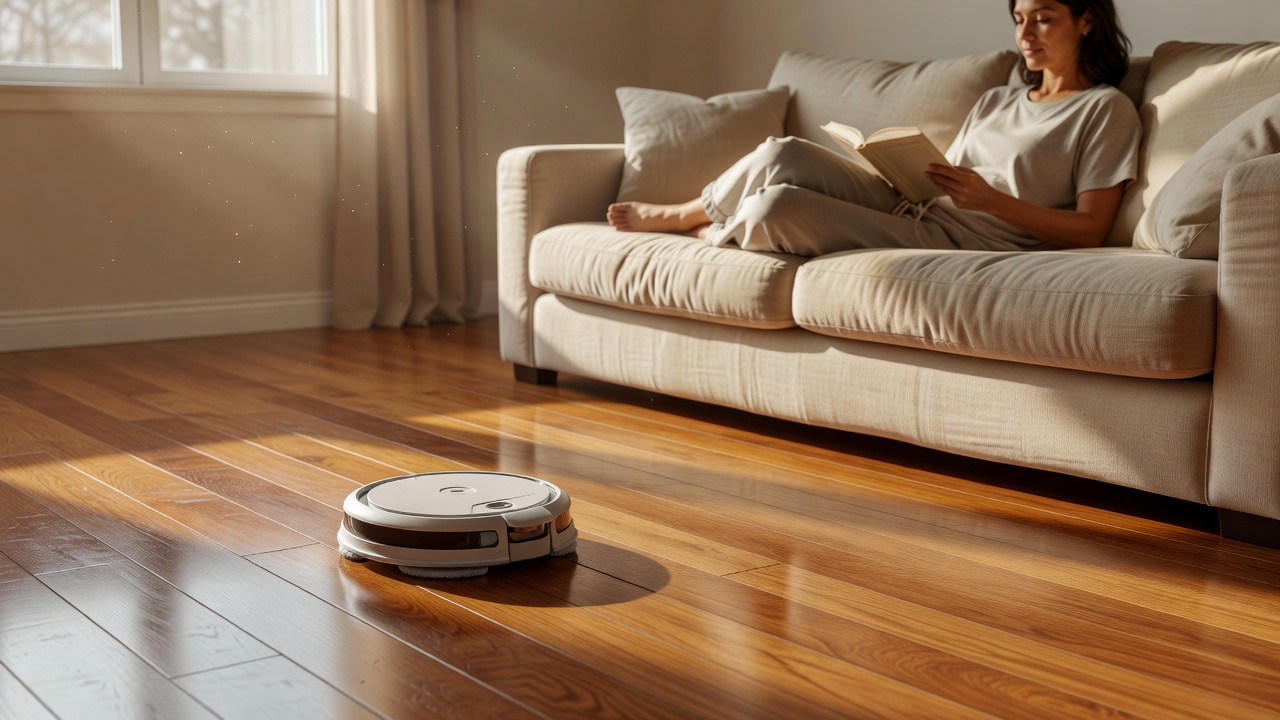
Zero-touch, mostly
A robot vacuum is the top rung of the effort ladder. You press a button once, set a schedule, and from then on the only chore left is emptying a bin. With a self-emptying dock, even that happens only every few weeks. Brands such as iRobot's Roomba, Roborock, Eufy, Ecovacs and Shark have made the category mainstream, and the spread between cheap and expensive models is wide. Here is how to buy one without reading forty reviews.
How they find their way
Navigation matters more than suction numbers. It decides whether the robot covers the whole floor or bounces around the kitchen until the battery dies.
| Navigation | How it works | Lazy verdict |
|---|---|---|
| Bump and run | Bumper sensors and semi-random paths | Cheap and slow, gets there eventually |
| Camera mapping | Uses a camera to recognise the room and its furniture | Good in decent light, needs a tidy floor |
| LiDAR | A spinning laser builds a map, popular with Roborock and Ecovacs | Fast, works in the dark, easy no-go zones |
The dock is where the laziness lives
A basic robot still needs you to empty a small dust bin after most runs. A self-emptying dock moves the dust into a larger bag. The trade-off is a recurring cost for replacement bags and a taller footprint. Some newer docks also wash and dry the mop pads, which removes the grimiest task in robot ownership. If you are buying for zero-touch, the dock is worth more than extra suction.
What to check before you buy
- Obstacle avoidance: cables and socks are the classic robot killers. Models with cameras or 3D sensors cope better.
- Brush type: rubber roller brushes tangle less with pet hair and long hair than bristle brushes.
- Filter: HEPA H13 (defined in European standard EN 1822) is the usual mark of a high-grade filter.
- Climb height: check thresholds and rug edges against the spec sheet.
- Noise: look for a decibel figure and a quiet mode if you work from home.
- Spare parts: can you buy brushes and filters for it in two years?
Independent test houses such as Which? and Consumer Reports publish comparisons that are more reliable than a product page.
Robot mops: useful, with strings
Dedicated mops such as iRobot's Braava line and hybrid vacuum-mops from several brands handle light, daily floor film. They will not shift dried-on spills like a human with a bucket. Choose a model that lifts the mop on carpet, and be careful on unsealed wood. Think of a robot mop as a way to keep floors from getting bad, not a rescue service.
The effort that remains
Be honest about the sock tax. Before the run, lift cables, socks and anything the robot might swallow. Then do a quick maintenance pass: empty the bin or bag, cut hair off the brush, rinse the filter if the manual says it is washable, and wipe the sensors. Most makers recommend replacing brushes and filters every few months. That is about five minutes a month.
Where the robot stops
Robots do not do stairs, upholstery, ceiling cobwebs or tight corners. Keep a small handheld vacuum, such as a Black+Decker Dustbuster-style model, for the spots the robot can't reach. Run the robot while you are out, so you never hear it, and come home to floors that look like someone else had a productive day.